Sunday, 10 July 2011

Scorched in Tucson

Walking in Tucson, Arizona is like walking in an oven. The daily temperatures regularly exceed 40 degrees Celsius, just over 100 Fahrenheit. Unlike most places, the breeze only makes this worse: the wind burns, not cools, and whips you with stray grains of sand. This is because Tucson is a city in the desert (the Sonoran desert to be exact), in one of the hottest areas in the USA.

Woo, cacti!

The city is organized roughly in a grid formation, with the downtown central business district being on the west side of town. Outside this, the city spreads out to the east, north and south with block after block of spaced out malling. It just so happened that on our first day there we spent most of the afternoon in such a strip mall, buying a new camera after our other one sadly died a death at the San Antonio Riverwalk. RIP, Old Faithful.

Being as it was very hot, we didn't spend much of our time walking around outside. Balmy air-conditioned interiors were far more appealing. That said, we did dedicate a day to roaming around the downtown historic district. Having seen the rather impressive county courthouse, and taken photos with the giant cacti that surrounded it; we checked out some old-style homes. Unfortunately, that was pretty much all there was to the historic district. The silver lining on this was that we could escape and lounge in the coolness of the hotel pool without a guilty conscience.

Tucson Courthouse, located in the Historic District

Old Town

A very friendly cactus
We also spent the 4th of July there, and had a fantastic time! We managed to get tickets to a local baseball game, with supplementary fireworks, thus killing two birds with one stone: celebrating the 4th in a suitably all-American manner, and introducing Dex to the American past-time. Boy, did it live up to expectations. The ball game was suitably long-winded, the crowd was suitably large (in more ways than one), and the patriotic sing-along at the end was suitably cringing. If any of you were wondering, unfortunately the Tucson Padres lost. There's nothing quite like sitting with a numb bottom in the bleachers, clutching a bucket-sized soda (a 'regular', of course) and watching the local pros hitting home runs into the cheering crowd. By the end of our stay we felt like we'd witnessed some genuine Americana, the sort of stuff more touristy places lack.

Dex VERY excited to be at his 1st baseball game.. it wore off by the 6th inning

GO PADRES!!!!!!!!
No 4th of July b-ball game is complete without fireworks

Tuesday, 5 July 2011

Everything's bigger in Texas...

...apart from the historic monuments. Having arrived in San Antonio, TX at a bleary-eyed 3am on the 30th, we took a taxi straight to our hotel and slept like logs. The next morning we rose early to see the famous Alamo fort in central San Antonio. We were rather disappointed. It is essentially a walled garden, with two squat stone buildings inside. One houses a room full of flags, and the other is a gift shop disguised as a museum. Needless to say, the gift shop is bigger than the 'historical flag' building. The whole site takes all of about 10 minutes to see. We took the obligatory photo outside the front gate, and felt rather underwhelmed. Maybe it's because one of us is Greek and the other is British, and we're used to routinely seeing much larger and older historical sites!

The Alamo..

The other big draw in San Antonio is a real estate project called the Riverwalk, which sits in the middle of the Central Business District. It is essentially a human-made river system which runs about four meters below street level, past rows of cafes and restaurants, through open-plan buildings, and even through a mall. It has to be said, it is quite beautiful. It tries to channel places like Venice, and certainly has a somewhat Mediterranean feel to it. This is strange, given it is situated in the middle of heartland Texas.


If any of you happen to be driving through San Antonio, definitely stay for the day. The Alamo is free to see, and a walk along the Riverwalk is certainly pleasant (although that's where MaryAnn's camera broke!). There are loads of restaurants and cafes, so that would definitely make for a nice evening for those not on a student budget. Other than that, there wasn't much else to see, or many bars or places to go out. There are missions, but you need a car. For all we know San Antonio has a raging nightlife on the outskirts of the city, but from our experience there wasn't much catering to the younger, collegiate crowd. This could be because there isn't a strong university presence in the city. So all in all, San Antonio makes a great day trip for you tourists, but we wouldn't recommend staying for much longer.

Oh, and for one other reason. Being in Texas, the city has some mighty fine Texas BBQ joints and Mexican restaurants. Being the USA, and being Texas, the portions are huge; also expect to have a (complimentary) huge cup of (very) sweet iced tea with every meal. If you are a fan of your teeth, however, ask for unsweetened. On our last day, 2nd July, we went to a small Mexican restaurant called the Oasis Cafe. Their food is fantastic. If you're ever in San Antonio, look it up and check it out. It is very reasonably priced, and close to the city centre. More likely than not you'll have some leftovers to take home with you as well. We got cheese enchiladas, which were fantastic.


Real Texan souvenirs 
On the 2nd of July we hopped on the train to Tucson, AZ. It's a shame that we got a new camera after this leg of the train journey, as we passed by some fantastic scenery. Probably our best yet, if we're being honest. Isolated ranches, cowboys and ranchers with wide-brimmed white hats, and the endless Southwestern desert.. it was beautiful. Yes, we saw cacti and tumbleweed! Apparently, you can tell the social class of a rancher by the hat he wears and the type of cowboy boots he owns. The middle-class rancher, with a decent-sized ranch, usually owns a black hat. The really well-to-do ranchers (and by well-to-do they can own up to tens of thousands of acres of land) have the white hat as their hat if choice, with the 'X's' on the back denoting value (the more X's the more expensive it is, and they can run pretty damn expensive). There's also something about the length of the brim and the crease on the top. We don't know much about how you can tell a 'good' pair of cowboy boots from 'cheap', and tbh we're pretty clueless about the hats as well, but they can be quite extortionate. Note: as we were updating our blog on the iPad (we're in our hotel lobby in Tucson), a rancher with a white hat came up to us to joke about how much faster we type on our iPad than he does on his. Haha!

One particularly interesting view we saw was just passing El Paso, Texas. For those of our friends who don't know where this is, it's basically right on the border between the states and Mexico, with Juarez, Mexico right on the other side of the Rio Grande. We probably passed 7 US Border Patrol vans in the 5 min span we were going through El Paso. We weren't really surprised by this: Juarez is infamous as one of the most dangerous cities in Mexico, called "the most violent zone In the world outside of declared war zones." Thousands of people have died from the drug cartel violence and homicides in the city and even on US soil (from gunmen shooting from behind the fence) to the point where businesses in the city pleaded for UN intervention. You always hear about it in American news, but it's another thing to actually pass by the slums crowded right next to the border.


Juarez slums near the border, photo not our own

You can definitely understand on the one hand how the two cities' proximity and the presence of drug gangs has caused a lot of tension, and on the other why Mexican families are so desperate to hop the border to escape abject poverty and crime. And it'll continue to be an issue, until lawmakers on both sides work better together and perhaps create more efficient citizenship pathways for those families who are well-intentioned and want a better future for themselves and their children.

We're just finishing up our stay in Tucson, AZ: getting a burger from Lindy's and walking around the historic district downtown. More to follow in our next entry, peace!

Thursday, 30 June 2011

The Big Easy

New Orleans is awesome. Totally awesome. It is, without doubt, the best city we have encountered so far in the States, including New York. And that's saying something.

The funny thing is, it doesn't really feel American. It has its own indomitable spirit, and draws heavily from its Cajun, French and Spanish heritage. You won't see many stars-and-stripes down here, but you'll see the Fleur-de-Lys liberally plastered on almost everything. The cuisine is totally different from the rest of the United States, and the whole city (and indeed the state) has a deeply festive atmosphere, not just during Mardi Gras, that the surrounding states such as Alabama and Mississippi, don't seem to have as much of.

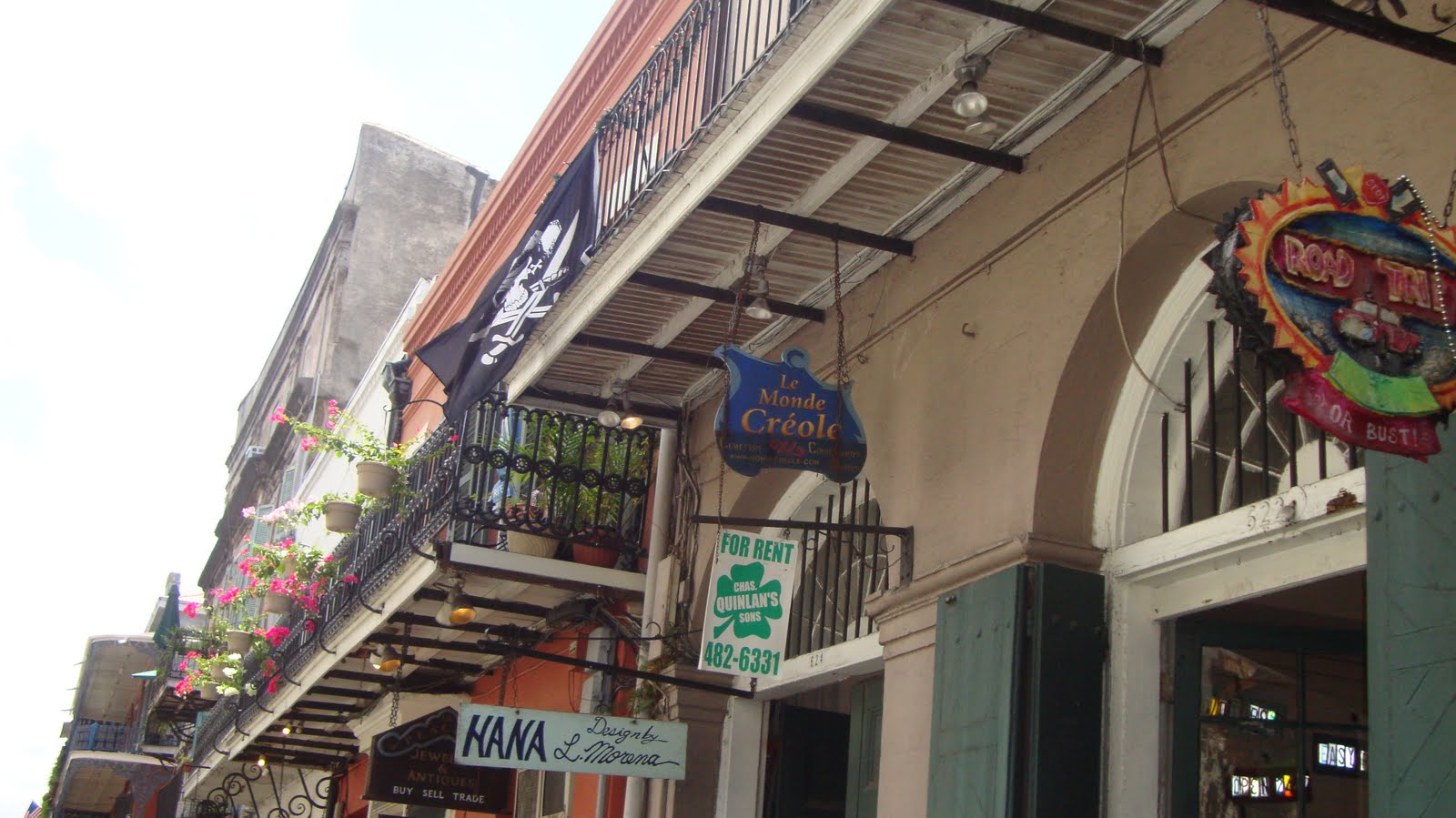
Shop signs and verandas in the French Quarter
Part of the reason it is so fantastic is that it's rather liberal when it comes to alcohol consumption. Any supermarket or cornershop is allowed to sell it; one is allowed to drink in the street (plastic cups only); and while the drinking age is 21 like the rest of the States, most establishments are somewhat relaxed, far more so than they are in the Northeast, say.

Bourbon St at night, photo not our own

So on the first night it was hardly surprising that we found ourselves holed up in a restaurant just off Bourbon St., with a bowl of Gumbo and fried alligator in front of us and two pints of the 'local brew' in our hands. After supping, we took a wander around the French Quarter. In the day, this historic district is full of restaurants selling Cajun and Creole food, quaint museums and fantastic cafes. At night, the place comes alive. Bourbon Street especially. Neon signs burn your irises as you walk down row after row of late-night bars, seedy strip clubs and dive eateries. Live music blares out of every venue: usually jazz, blues or rock. Bar employees stand outside beckoning to people to enter: cover charges seem not to exist here (thank god), and bouncers put up only a token resistance if you're under 21. Far from marking your hands and practically segregating you as they do in New York and other places, you are usually waved inside with a fleeting "ok, you're not allowed to drink, right?". Nobody asks any questions on the inside, and there's nothing to differentiate you from the other punters. Its nightlife feels very similar to that in some of Europe's party centers: think Ibiza, Agia Napa or the Greek Islands of Ios or Mykonos. Advice for future travelers: definitely go through Bourbon St for the experience, but to get a better sense of the local flavor head down to Frenchmen St (only a 5 min walk from Bourbon) and check out the jazz bars and hole-in-the-walls. There are always live acts at the bars there that locals and musicians alike flock to at night.

The infamous Bourbon St., in the daytime.
It isn't just a party town, of course. New Orleans is steeped in culture, by virtue of its multinational heritage. On Monday, a walk around the French quarter in the day yielded views of beautiful French and Spanish architecture, narrow streets and the intriguing sensation of walking 'up' to the river. We perused the daily Farmer's Market, which sells all sorts of interesting foodstuffs, and made the mistake of sampling some Ghost Pepper sauce (apparently the strongest pepper in the world).


Outside of the French Market
The real thing: N'awlins Ghost Pepper Sauce

Needless to say Dex spent the next two hours with a numb tongue, stomach ache and headache. On the 'Scoville' scale of pepper heat, the 'Ghost' pepper has about 800,000 to 1,400,000 units. A jalapeño has about 5,000, and Tabasco about 50,000. That says it all, really. To soothe our numb mouths we sat down at the first established cafe in NOLA (Cafe du Monde) and enjoyed a much-needed cafe au lait and some beignettes, so-called French doughnuts with powdered sugar on top.

Dex with the Cafe du Monde goodies

Later that afternoon we took the antique St. Charles streetcar into the Garden district, and to the districts to the west of the French Quarter. We saw some stunning 'Southern mansions', and got a feel for public transportation in the Big Easy circa A Steetcar Named Desire era.


St. Chaaaaaarles Streetcar

New Orleans food is pretty interesting. It all seems to be some form of seafood broth served with rice. Gumbo, the classic, is filling and tastes fantastic. Jambalaya and red beans n' rice are ok, but nothing quite beats étouffée dishes, specifically with shrimp or crawfish. Crawfish étouffée is highly recommended. There is also a lot of alligator on offer, which tastes like tough chicken with a slight seafood flavor.

New Orleans is also situated in a rather unique environment. It is caught between a lake and a river, themselves situated in a huge bayou. We ventured into this bayou on Tuesday, when we went for an swamp tour! We highly recommend it to anyone who finds themselves in NOLA. We were taken through the swamps and saw birds, turtles, and of course.. Alligators!! We have quite a few photos from the tour (see below). The tour also took us to a Cajun village (the residents are known as 'the swamp people'), and learned about their past and present way of life. Quite a few residents are new and reconstructed their own swamp homes after Hurricane Katrina, which completely destroyed the majority of the homes. Interestingly, a few of the homes sported Confederate flags...

The Bayou
Maryann with a baby gator, d'aw

An, erm, much bigger alligator, nicknamed 'Cindy'

Swamp People, don't mess
It's shocking to see how the devastating effects of Hurricane Katrina are still felt throughout the Big Easy. As we drove to the bayou, our driver pointed out the 9th ward, one of the areas most affected by the storm, where most of the homes were still destroyed. In other areas, just this year have businesses reopened their stores in the lower levels that couldn't weather the storm as well as the historic districts (which are situated much higher above sea-level). In the 6 years since the storm hit, thousands of previous New Orleans residents are still living in temporary accommodations in Louisiana and Mississippi. Needless to say, while the Big Easy soldiers on with life, Hurricane Katrina has definitely cast a shadow that will take time to pass.

Monday, 27 June 2011

1st Big Train Journey (21 hours)

So, after waiting in Lynchburg until almost midnight, we boarded our train. Instead of doing a lengthy and verbose blog about the Amtrak train system, a few succinct bullet points will do:

- the trains get very cold at night (they leave the aircon on full)
- they stop once in a while to let freight trains pass, and are often somewhat late to their destinations. Don't take them if you are on tight deadlines.
- the seats are absolutely fantastic, far better than plane seats. They have more than enough legroom, are nice and wide, and are quite comfortable to sleep in.
- bring your own food and entertainment. This is a must, since the train prices are rather high; and there is no on-board entertainment.
- the windows are very broad, so you get an amazing view of the passing landscape and get a great feel/glimpse of the area.

The Viewing carriage, available on all long-distance Amtrak routes.


As we journeyed on through the South, we had quite a few interesting views. We passed many quintessential suburban Southern towns (no, we didn't see a Confederate flag anywhere). It's interesting that quite a few of our stops along the way included historic towns that have lovely historic districts, yet run-down modern additions. This was definitely noticed at Lynchburg: on the one hand you have the pretty, upmarket historic district, with pretty Southern homes and cutesy antique shops; and on the other you have a very poor community that is sharply segregated from the picturesque downtown. This seemed to be a repeated pattern throughout the South, where one block sometimes meant all the difference.

Another was when we travelled through Alabama. As some of our fellow Americans may have heard, tornados ripped through areas of the state in April, completely demolishing some towns and taking a toll on the community, emotionally and financially. Well, we passed one of those towns. After passing through desecrated woodland, the rails eventually shifted and we were right on the edge of a small town: homes and shops completely destroyed, cars flipped over, trees all over the place. It's one thing to see it on television, it's something else to see it in person. It was unbelievable and shocking, to the point where every passenger just stared transfixed at the scene before us. We didn't take a photo. A scene Maryann probably won't forget for a while is the sight of a man walking up his front lawn with the morning newspaper in regular routine, up to his home that was half destroyed. It's shocking and infuriating that these towns are in the state that they are in nearly 2 months after the event; interesting comparison to the NOLA scandal.

On a completely different note, we also caught a glimpse of an amazing sunset when we were crossing the bay over to Louisiana! Photos to follow.

Saturday, 25 June 2011

Interlude 1, Lynchy-lynch & our 1st Big Train Journey

Our bus left early in the morning the next day, so we bade DC farewell, and began the long journey down south, stoppin' at... Lynchburrrrrrrrg, VA!!

We actually almost didn't make our connecting bus. Our Greyhound didn't leave from DC until half an hour after scheduled departure, so we were basically biting our nails from there to Charlottesville, where our connecting bus was. In Britain we would have just brushed this tiny inconvenience off, since in Europe there are loads of buses leaving practically every minute. Not so in the US of A, where everyone has a gas-guzzling SUV that can take you anywhere, anytime you please. Luckily the other bus waited for us and a few other passengers, and we were on our way, with MaryAnn's nails half-intact.

While the town name leaves a lot to be desired, Lynchburg is actually quite a pretty Southern town! One of the first things we noticed down South is that there are loads of churches. As in, one on every block. It's very interesting how while Dublin and London have a pub every block, the south has churches. Another thing you are struck by is the hospitality. When we were walking down the sidewalk people would say "good day" or "how're you doin'?", definitely something you don't find in the Northeast or in Europe! People were also more than helpful with helping a lost Brit and Yank find their way to the historic district, or recommend some good places to chow down on some grub. A word of advice to potential South-bound travelers: many shops and eateries close from 2-5:30 for siesta, so don't be too surprised or exasperated to find nothing open at 3:00! Not like we're speaking from experience of course...

As we had the afternoon free, we explored the historic downtown district, weaving our way through the main streets and avenues. Lots of Antique shops and cutesy boutiques. We were recommended by a local to a cafe called 'The White Hart' which does a mean Mac 'n' cheese, FYI. It bases its aesthetic around the Oxford University 'Inklings' society, and thus has a bookish, scholarly feel to it - a great contrast to the surrounding townscape it is situated in.

Downtown historic district, photo not our own
After sitting down for the meal, we decided to hit the sidewalk en-route to the Amtrak station for our first long-leg train journey!! Our excitement was amusingly diluted in two ways. One: Lynchburg is built in a valley. Meaning when you walk to certain destinations, expect to either be walking downhill for 40 min, or uphill. Of course, we had to trekk up the steep streets. Word of advice: take a bus/car. Unless you're planning on working off 7/11 nachos with chili and cheese, which we got in desperation. So in hindsight, maybe it was for the best. Next, when we finally got to the train station, we found out that our train was delayed an hour.. Then an hour and a half.. Now two. Haha. Oh well, part of the Amtrak experience! We're actually waiting in the train station for our train as we type, at 11.30pm. What fun. Anyway, until New Orleans!

Front of Lynchburg Amtrak train station

Raving it up at the station

Find us at the capital: Washington DC

Hey all! Currently we're both waiting for a much-delayed train at Lynchburg, VA that'll eventually take us to the Big Easy. So, what better way to pass our time than update our blog (which needed updating anyway)? Apologies for the lack o' foe-toes; they'll be put up as soon as we get access to a CPU.

On Wednesday we drove into Philly, and finally embarked on our rail trip proper. Woo! The train ride to Washington DC was brief, and after two hours we arrived in Union Station.

The first thing we planned to do was to take the Metro system to our hotel, which was located up in College Park on the outskirts of the city (technically in Maryland, Washington DC being a tiny city-state). So, we entered the Metro system... and were confronted by ticketing machines which looked more like computers from the 70s than anything else.


D'oh?
The displays were like those on really, really old calculators; and apart from that we were presented by a mismatched assortment of buttons, labels and stickers creating varying levels of confusion. Add really long queues/ lines of grumpy DCers and... yeah. Needless to say it took a while to work them out, but after observing commuters in their local habitat we got the idea and hit the tube.

An aspect of DC that many of our American readers may know of, but our international compadres may not, is that outside of center-city there are some of the most dangerous neighborhoods in the USA.. Even rivaling New Orleans. Gang violence and homicides were particularly high during the 1990s, when DC was known as the 'murder capital' of the states. To be fair, it has gotten better: crime rates have gone down drastically in the past few years, and the two of us didn't have any problems when we took the metro past the outskirts of town on our way to College Park, MD. Some neighborhoods to the east, like Prince George County (the stop right before ours on the green line), are getting worse however.

Our hotel was right next door to the University of Maryland's College Park, and was a stone's throw away from rows of suburban frat houses.

Having dropped off our stuff, we took the metro back down to DC (a day pass is $9, and is worth it if you do more than two trips in a day) and saw all the must-see touristy sites. We checked out the Capitol building, the Washington Monument, the White House, and had a brief glimpse of the Lincoln Memorial from afar.


The Capitol Building, D.C.
Washington Monument

All of these are located relatively centrally, and all are about a medium walking distance away from each other (apart from the Lincoln memorial, which is a bit more of a trek). This is because centre DC is organized around the National Mall, which is essentially a large strip of grass which runs for about 2 miles from the Capitol in the East to the Lincoln memorial in the West. The grass wasn't quite as well-kept as the lawns of the government buildings, but hey, what do you expect?


That evening we went back to the hotel and tried out the pool, much to Dexter's delight. Such things are a bit of a novelty for those who hail from rainy Britain. Poor chap ;)

At the Capitol end there are lots of museums, conveniently close to each other, and conveniently free. So, the next day we decided to hit the museums! DC, like any good national capital, has the standard selection of National Galleries, Natural History Museums, etc. But as a wise person one said, "once you've seen one natural history museum, you've seen them all", and going by this logic, we made a bee-line for the museum that sounded the coolest: the Air and Space Museum. Good idea, because it was wicked.

It has some pretty cool stuff inside, like the Apollo 11 command module, the Apollo 11 'Eagle' Lunar lander, a walk-in section of the Skylab space station, a lunar rover, a prototype of the Hubble Telescope, a prototype Voyager probe, a prototype Viking Mars lander and some early Mercury command modules, to name a few things. And that's just the Space section. There were other interesting things, like one of the Wright brothers' first aircraft, a jet-powered Messerschmidt and some (supposedly decommissioned) nuclear missiles... but it is pretty hard to beat the Space displays. (Yes, Dex wrote this section) After this we found we has little time for anything else, so we quickly headed over to the Library of Congress, and then to the National Archives. We found the archives were closed, however, because Laura Bush was making a speech there that evening. Boo!

A replica of the Apollo 11 Lunar lander in the Air and Space Museum.

That evening we met up with our good friend Cristina, who is interning at PETA for the summer. We walked around the Adams Morgan district, and caugut dinner at a bookstore-restaurant-bar. Afrer dinner we heard there was a free open-air screening of the film ET down at the Navy Yard metro stop, so we headed down there and enjoyed ourselves greatly.

Outdoor cinema in DC.

DC itself is a rather small city, considering it's a national capital. New York, for example, is far, far larger. The areas around the Mall are quite nice, although for some reason a lot of the grass in the parks is unkempt... as mentioned above. To the North of the museums area of the Mall you have a very small Chinatown, which soon gives way to Adams Morgan, and Dupont in the west. These areas have a 'trendy' feel, not unlike some of the more grimy-yet-trendy districts in London or Paris. Outside of these, it's pretty much grimy urban decay until you reach the far outskirts.

The next day we went back to the National Archives, and after over an hour's wait outside in the searing sunshine (again for effect, SEARING) we finally entered and got to see the Declaration of Independence, the Constitution and the Bill of Rights; and toured round a very interesting exhibit on the way in which the US government has tried to influence what Americans ate over the past century, particularly in wartime etc. We then walked down to the Lincoln Memorial. While we expected a dazzling view of the Washington Memorial's reflection on the, you guessed it, Reflection Pool, it was completely drained and being 'fixed'. Yes, it is high tourist season in DC atm. No, we don't understand why they chose June to fix it up either. Maybe because we were there, as drained pools became a theme in our trip. We trudged back up to the National Archives, where we waited (in vain) for a hotel shuttle to pick us up. For over an hour. Lawlcats n00bcopter phail fml. In the end we took the metro.

The empty reflection pool, as seen from the Lincoln Memorial. Can't get more unique than this.

Wednesday, 22 June 2011

and so it begins...

Our rail trip proper is starting today. For all our outings up until now we used Egg Harbor Township as a base, but today we're heading over to Philadelphia and hitting the rails. Our plan has been revised somewhat, so now we plan to go down the Washington DC today, and from there we're taking a bus to Lynchburg, Virginia, and from there a train to New Orleans. Then our travels will take us along the bottom of the country, stopping at San Antonio in Texas, Tucson in Arizona (if it isn't on fire) and finally to Los Angeles, California. From here we'll hop to San Francisco and Las Vegas, and then onwards to Albuquerque, for White Sands, Roswell etc; and then we'll take the train up to Chicago and back to Philadelphia. I would create a map, but it's pretty much the same as the one on the first post of this blog, except with the cross-country line stopping at Chicago before returning to Philadelphia.

It's a long way. And it looks like we'll be spending half our lives on the train. But we cannot wait...